The Rise of Technical Support Engineers

A customer reports that checkout is broken. Your tier-1 support agent collects screenshots, asks clarifying questions, and escalates to engineering, who discovers the issue is a misconfigured Redis cache that anyone with log access could have diagnosed in thirty seconds. This scenario plays out thousands of times daily across software companies, burning engineering hours and stretching resolution times from minutes to days.
The support engineer role is splitting into two distinct paths: traditional customer service focused on account management and product guidance, and technical support engineering that requires reading distributed traces, debugging API calls, and resolving production issues without escalation. We'll examine why this shift is accelerating in 2026, which technical skills support teams are adopting, how AI is reshaping (not eliminating) work, and what this transformation means for career paths and team structure.
The forces turning customer support into engineering
Back in 2020, a CISO made a bold prediction: "Tech support jobs will be dead in a year." Fast forward to today, and tech support isn't dying. It's transforming into something fundamentally different. The role is becoming more specialized and integrated within core engineering functions, requiring technical expertise rather than just soft skills and product knowledge.
Three forces are converging right now that traditional tier-1 support can't handle anymore:
Cloud complexity and microservices
When applications lived on a single server, troubleshooting followed a straightforward path. Today's software runs across distributed systems - dozens or hundreds of services spread across multiple cloud providers, regions, and containers.
Microservices architecture breaks applications into small, independent components that communicate through APIs (application programming interfaces - structured ways for different software systems to talk to each other). A single customer issue might originate from any of these components or the connections between them. The customer reporting "slow checkout" might be experiencing a database connection pool exhaustion three services deep in the call chain, visible only through proper observability tooling.
Rising customer expectations for instant fixes
SaaS customers expect 99.9% uptime, real-time incident updates, and resolutions measured in minutes rather than days. When their business-critical workflow breaks, "we've escalated this to engineering" translates to lost revenue and broken SLAs (service level agreements - contractual promises about system availability and response times).
The engineer who can identify a misconfigured webhook, test it with a cURL command, and provide a fix within the first response becomes exponentially more valuable. Traditional support that collects screenshots and waits for engineering availability can't meet this bar.
Escalation costs hitting engineering sprints
Every support ticket that lands in an engineering team's queue carries hidden costs. Context switching pulls developers out of deep work, sprint commitments slip, and feature velocity drops.
Organizations are realizing that hiring technical support engineers costs less than the productivity drain on their core development teams. A support engineer who can resolve 70% of technical issues independently delivers immediate ROI by protecting engineering focus.
Technical skills for support teams in 2026
The gap between traditional support and technical support engineering comes down to specific, learnable competencies. Here's what's changing.
1. Reading logs and distributed traces
Application logs tell the story of what happened when something broke. Distributed tracing connects that story across multiple services, showing the full path of a request through your system - like following a paper trail through different departments.
A technical support engineer reads these artifacts the same way a doctor reads medical charts. The difference between saying "the API returned an error" and "the authentication service timed out after 5 seconds because the Redis cache was unreachable" is everything. One response requires engineering escalation; the other points directly to infrastructure monitoring.
2. Scripting and automation with Python or Bash
Repetitive tasks are the enemy of support efficiency. A support engineer who can write a 20-line Python script to bulk-update customer configurations, parse log files for specific error patterns, or automate data exports saves dozens of hours per week across the team.
These scripts don't have to be production-grade software - they just have to work reliably for internal tooling. Basic proficiency with string manipulation, file I/O (input/output operations - reading and writing data), and API calls opens up enormous productivity gains.
3. SQL and data analytics for self-serve insights
Customer questions often boil down to data queries: "How many users logged in last month?" or "Which accounts are using deprecated API endpoints?" SQL (Structured Query Language) is the standard way to ask databases for specific information. A support engineer who can write SQL queries answers questions in minutes rather than filing data requests with engineering or analytics teams.
Beyond simple SELECT statements, understanding JOINs (combining data from multiple tables), aggregations, and basic query optimization allows support to generate custom reports and identify trends that might indicate broader product issues.
4. API debugging and Postman proficiency
Modern software connects to everything - third-party services, customer systems, internal microservices. When integrations break, customers report symptoms ("data isn't syncing") rather than root causes.
A technical support engineer uses tools like Postman to reproduce the customer's API calls, inspect request headers and payloads, verify authentication tokens, and identify whether the issue stems from the customer's implementation or your service. This troubleshooting happens in real-time during the support interaction rather than through multi-day escalation cycles.
5. Security and compliance basics
Support engineers often have elevated access to customer data, production systems, and sensitive configurations. Understanding data handling best practices, access control principles, and compliance requirements (GDPR, SOC 2, HIPAA) becomes critical as the role gains more technical responsibility.
This knowledge also helps support engineers recognize when a customer's issue involves security implications - like exposed API keys in error messages or overly permissive access controls - and escalate appropriately.
AI and automation inside the modern help desk
Generative AI is reshaping support workflows, but not in the "robots replacing humans" narrative that dominated headlines. AI handles the repetitive pattern-matching tasks while human technical judgment becomes more valuable.
Large language models for ticket triage
LLMs analyze incoming support tickets, extract key information, categorize issues by product area, and assign severity levels with surprising accuracy. A well-trained model can distinguish between "I can't log in" (authentication system, high urgency) and "I have a question about billing" (finance, standard priority) instantly.
This automated triage means technical support engineers spend less time reading through poorly formatted tickets and more time solving complex issues that actually require their expertise.
Pro tip: Try Jam MCP with your AI tools, so you can give them instant bug context without prompting. Go from bug -> ticket -> PR, without switching tools.
Generative replies and customer comms
AI-assisted response drafting suggests replies based on similar past tickets, documentation, and conversation context. However, the technical support engineer still reviews, edits, and approves responses - especially when they involve technical troubleshooting steps or security-sensitive information.
The value isn't in copy-pasting AI responses verbatim. It's in reducing the cognitive load of starting from a blank text box for the 47th "password reset" ticket of the day, freeing up mental energy for harder problems.
Predictive escalation routing
Machine learning models can predict which tickets will require engineering involvement based on keywords, error patterns, customer account characteristics, and historical escalation data. Tickets get routed to senior technical support engineers or directly to on-call engineers, while clearly resolvable issues stay in the standard support queue.
This predictive routing reduces average resolution time and prevents situations where a critical bug report sits in the general queue for hours before someone recognizes its severity.
The tool stack powering shift-left debugging
"Shift-left" means moving problem detection and resolution earlier in the process - solving issues at the support level rather than escalating to engineering. This requires giving support teams the same diagnostic tools that engineers use.
1. Screen capture and bug reporting with Jam
When a customer reports "the button doesn't work," the first challenge is understanding their environment, browser state, and the exact steps that led to the issue. Comprehensive bug reporting tools automatically capture console logs (error messages and warnings that appear in the browser's developer console), network requests, browser details, and user actions in a single click.
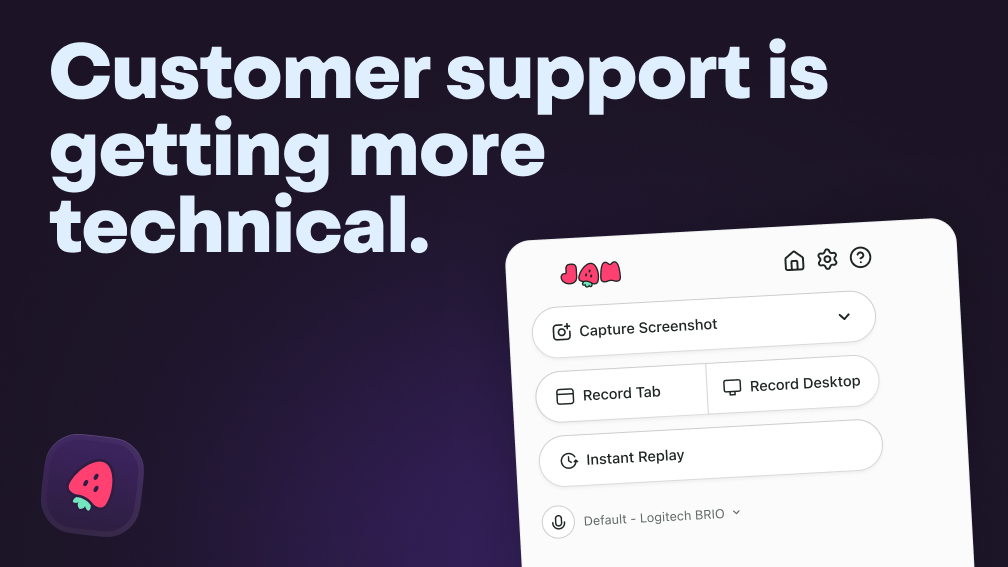
Jam captures all this technical context automatically - console errors, network traffic, device specifications, and reproduction steps - then packages it into a shareable link that integrates directly with tools like Jira, GitHub, and Slack. A support engineer can gather engineering-grade bug reports without asking customers to open DevTools or explain their browser version.
2. Observability dashboards and log search
Tools like Datadog, New Relic, and Honeycomb give support engineers read-only access to the same system metrics and logs that engineering uses for troubleshooting. When a customer reports slow performance, support can check service response times, error rates, and resource utilization before escalating.
This visibility transforms support from "message relay" to "first-line diagnostician." Many issues get resolved with configuration changes, cache clears, or identifying known incidents without ever reaching the engineering backlog.
3. Feature flag management
Feature flags allow teams to toggle functionality on or off without deploying new code. Support engineers with feature flag access can resolve entire categories of issues instantly - disabling a problematic new feature for a specific customer, enabling beta functionality for early adopters, or rolling back changes that caused unexpected behavior.
This capability requires trust and training, but it dramatically reduces time-to-resolution for configuration-related issues that would otherwise require engineering intervention or emergency deployments.
4. Incident response ChatOps
When critical issues emerge, coordinated response happens in real-time through Slack or Microsoft Teams integrations. Support engineers participate in incident channels alongside engineering, providing customer impact updates, testing proposed fixes, and communicating status to affected users.
This collaborative approach breaks down the traditional wall between support and engineering, creating shared responsibility for customer outcomes.
Career paths and salaries for technical support engineers
As support roles become more technical, career progression starts looking less like traditional customer service ladders and more like engineering career tracks. The earning potential and growth opportunities reflect this shift.
Senior TSE to solutions architect
Technical support engineers who develop deep product knowledge and customer-facing skills often transition into solutions architect roles. Solutions architects design customer implementations, conduct technical discovery, and solve complex integration challenges before they become support tickets.
The solutions architect role typically commands 30-40% higher compensation than senior support positions while maintaining the customer interaction that many support engineers find rewarding.
TSE to site reliability engineer
Support engineers who gravitate toward infrastructure, monitoring, and system reliability sometimes move into SRE (Site Reliability Engineer) roles. The troubleshooting skills, incident response experience, and production system knowledge transfer directly - SREs just focus on preventing issues rather than resolving customer-reported ones.
This transition works particularly well for support engineers who enjoy the technical depth but want to step back from constant customer interaction.
Leadership tracks in support engineering
Technical support teams require managers who understand both the technical work and the unique challenges of customer-facing roles. Senior technical support engineers often move into team lead, support engineering manager, or director of technical support positions.
A practical roadmap to upskill your support team
Transforming a traditional support team into a technical support engineering organization doesn't happen overnight. It requires deliberate investment, structured learning, and patience as team members develop new capabilities.
1. Skills audit and gap analysis
Start by honestly assessing your current team's technical capabilities against the competencies required for your product and customer base. Which team members already have scripting experience? Who's comfortable with SQL? Where are the biggest skill gaps?
This audit informs hiring decisions (hire experienced technical support engineers or upskill current team members?) and training priorities (which skills deliver the most immediate impact?).
2. Shadowing engineering on-call
Pair support engineers with on-call engineers for a week, letting them observe real incident response, troubleshooting methodology, and tool usage. This shadowing provides context that no training course can replicate - seeing how engineers think through problems, which tools they reach for first, and how they communicate uncertainty.
The reverse also works: having engineers shadow support interactions helps them understand customer communication challenges and the information gaps that lead to escalations.
3. Certs and micro-credentials
Vendor certifications like AWS Certified Cloud Practitioner, Microsoft Azure Fundamentals, or product-specific credentials provide structured learning paths and external validation of technical skills. Micro-credentials and online courses from platforms like Coursera, Udemy, or Pluralsight offer more targeted skill development - a Python fundamentals course, SQL bootcamp, or API testing workshop fills specific gaps without requiring months of study.
4. Tooling sandboxes and labs
Support engineers benefit from safe environments to practice technical skills without risk to production systems or customer data. Create staging environments, dummy datasets, and internal tools where team members can experiment with SQL queries, test API calls, practice log analysis, and break things without consequences.
Regular "learning labs" where the team works through technical challenges together - debugging a mock incident, writing automation scripts, or exploring new observability tools - build skills while fostering collaboration.
Measuring ROI when support gets more technical
The impact of technical support capabilities shows up clearly in operational metrics that directly affect the bottom line.
Escalation rate reduction
Track the percentage of tickets that require engineering involvement over time. As support engineers develop technical skills, this percentage typically declines -ideally by 30-50% within the first year of focused upskilling efforts.
Each prevented escalation saves engineering time, reduces context-switching costs, and allows developers to focus on building features that drive revenue.
Decreased MTTR and SLA penalties
MTTR (Mean Time to Resolution) measures how long it takes to fully resolve customer issues from initial report to confirmed fix. Technical support engineers diagnose problems faster, implement fixes independently, and communicate more precisely with engineering when escalation is necessary.
Lower MTTR directly reduces SLA breach penalties, customer churn risk, and the reputational damage that comes from prolonged outages.
Engineering velocity gains
Measure sprint completion rates, feature delivery timelines, and developer-reported satisfaction before and after implementing technical support capabilities. Engineering teams with effective support shields report 15-25% productivity improvements as they reclaim time previously spent on support escalations.
Technical support engineers are the new frontline
The transformation of support teams into technical support engineering organizations isn't a future trend - it's happening right now across the software industry. Companies that invest in this transition gain competitive advantages through faster issue resolution, better customer experiences, and more efficient use of engineering resources.
Start by giving your support team the tools they capture better bug reports and diagnostic information. Install the Jam browser extension to start capturing effortless, engineering-ready bug reports that include all the technical context your team requires to debug issues faster.
FAQs about technical support engineering in 2026
Will AI eliminate tier-1 support jobs?
AI will automate routine tasks like password resets, account provisioning, and answering common questions from documentation. However, technical support engineers will focus on complex problem-solving that requires human judgment, system understanding, and customer empathy - the role evolves rather than disappears.
How technical do support engineers become compared to software developers?
Support engineers develop diagnostic and troubleshooting skills rather than full software development expertise. The focus is on reading logs, using debugging tools, understanding system architecture, and knowing enough about code to identify where problems originate - not on writing production code or designing new features.
Which programming language do support engineers learn first?
Python offers the best balance of simplicity and utility for support tasks like data analysis, automation scripts, and API testing. Its readable syntax and extensive libraries for common support tasks make it ideal for engineers who aren't planning to become full-time developers. SQL is equally important for database queries.
Which engineering roles will be in demand in 2026?
AI and machine learning engineering leads demand, with India alone requiring 1 million AI professionals by 2026. Technical support engineering also grows rapidly as companies need engineers who can troubleshoot distributed systems, analyze observability data, and resolve issues without escalating to development teams.
How do companies give support teams production system access safely?
Organizations implement read-only permissions, audit logging, and staging environments that mirror production architecture without containing real customer data. Observability platforms like Datadog and New Relic provide investigation capabilities through permission levels that allow log searches and metric analysis without system modification rights.