How support and engineering collaborate at Attio
Elyse Mankin (Head of Support) and Philip Beevers (VP of Engineering) talk about how they their teams collaborate as Attio scales.

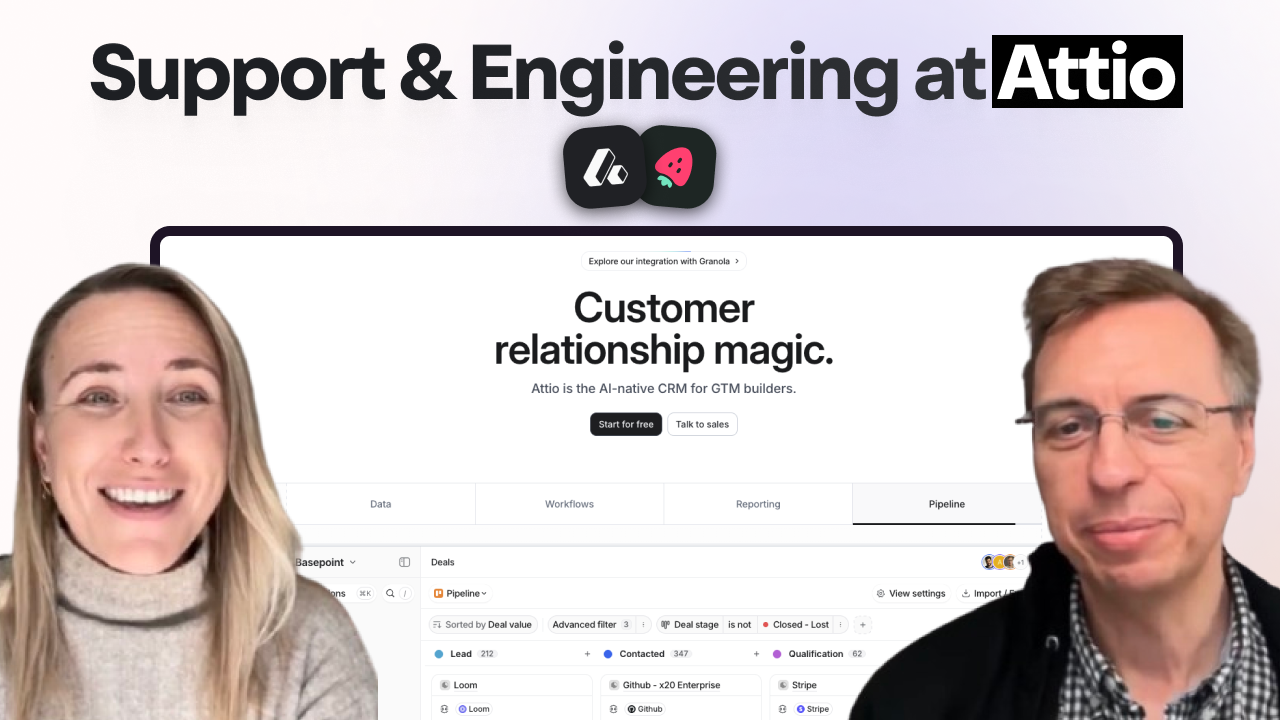
Attio is an AI-native CRM used by GTM teams at Granola, Replicate, Railway, and Public. They have been scaling extremely fast over the last year, with headcount nearly doubling. When a company grows that quickly, the seams usually show up first between the support and engineering teams.
At Jam we've been obsessed with how the relationship between these two teams is evolving. We sat down with Elyse Mankin (Attio's Head of Support) and Philip Beevers (VP of Engineering) to talk about how they keep that relationship healthy (and productive!) as Attio scales.
You can catch the full version on YouTube or read our notes below.
The natural tension point between support and engineering
Elyse doesn’t sugarcoat the fact that there is a natural tension between both teams, just by virtue of the timeframes they operate in, and what they're exposed to. Support sees the pain firsthand because they interact with frustrated customers who are blocked on something. They (usually) operate in a reactive paradigm.
Engineering teams couldn't be further removed from that. They operate based on the product roadmap, which is set months in advance, with clearly scoped objectives and longer timeframes.
“There is a natural tension between support and engineering… and that’s okay.”
Building empathy from day one
The inevitable question here is how can teams reduce the natural tension between support and engineering? For Attio, the answer is empathy.
Every new employee (regardless of role) spends time in the support queue, early in their onboarding process. It’s small, but direct exposure to customers' problems changes how people think about the product.
More importantly however, it changes how people treat the support team.
Just remind people there's a human being on the other end of this stuff.
Build trust between the teams before crisis hits
Both Elyse and Phil kept coming back to the same idea: you can’t build trust only when things are on fire. You need to build up relationship “credit” before you need to spend it.
Phil suggested two ways for teams to do this:
- Shadowing: He recommends all engineers to go sit with their colleagues in support, watch their workflows and help with tickets.
“You’re going to have so many ‘Oh, I never knew that’ moments.”
- Tabletop incident drills: At Attio they occasionally run incident simulations with support and engineering in the room, to build a bond way before its tested.
"A low-stress simulation for a high-stress activity."
Clear escalation starts with clear context
According to Elyse, the most critical thing the support team must do during tense moments is to reduce ambiguity.
“What we need to do from the support side is very clearly communicate the situation - the customer needs… and any changes.”
Lack of clarity is what makes both teams get short with each other. Not in the serious incidents where everyone knows to be on their best behavior, but in the “important… maybe?” moments where the urgency and importance of a problem is not clear.
Experimentation is the default (except some situations)
We wanted to understand how Attio is thinking about the plethora of new AI tools for customer support.
Both leaders want their teams experimenting constantly, but they draw one hard boundary: don’t experiment mid-incident. Outside of that, almost everything is fair game. Elyse used an interesting metaphor:
“We might not get to determine the house that we live in, but we get to figure out how to decorate it.”
It's important to set the guardrails for experimentation first, so it doesn't end up being chaotic.
What they’re building towards in 2026: 24/7 support
Phil and Elyse's big 2026 push is to move toward 24/7 support. Both of them were quick to highlight that this is not a support or engineering project. It’s a customer service delivery problem that will be co-owned by both teams.
“Delivering a service at three and a half, four nines… that’s not an eight hours a day operation.”
We had such a great time jamming with Elyse and Phil! It's clear that they've spent a long time thinking about (and battle testing) their ideas internally, and we think their approach could be a blueprint for support and engineering leaders orienting their teams for 2026.
We're looking to have similar conversations with support and engineering leaders to understand how their workflows are evolving. Sound like you? Drop us a note 🍓